Paul Finch & Helen Fields

Blackwell’s hosted a joint event with two crime writers this week. Helen Fields’ first novel Perfect Remains was published recently and Paul Finch has just launched a second crime series focusing on PC Lucy Clayburn, which begins with Strangers. The sixth book in his DS Heckenburg series comes out in April this year. They are both excellent writers and engaging speakers, no doubt about it, but it was the similarities in their lives before they became crime writers that made this pairing so interesting. Finch began his working life in the police force before moving into journalism, script writing and ultimately crime fiction. Fields spent 13 years in a different sector of law enforcement working as a barrister before she too moved into script writing and producing. She took a break from running a film production company with her husband in order to jump into crime fiction. The similarity in their backgrounds is offset by the difference in their appearances. Finch is every inch the burly former officer. Fields in contrast is petite and exquisitely neat.

Both Fields and Finch draw inspiration from the characters they met during their years in law enforcement and the stories they heard. Finch’s latest book, Strangers, features PC Lucy Clayburn going under cover as a prostitute, one of the most horrendously dangerous jobs a female police officer can be asked to do. In writing it he asked the advice of someone he knew who had done exactly that job on several occasions. While he won’t elaborate on the details he makes it clear that she had some truly insane stories to tell.

His day-to-day life as an officer also had an impact. Work in the police force often involved a great deal of camaraderie and banter, sometimes as a way to cope with their experiences and the inbuilt stress of the job. Finch tries to recreate as much of that environment as possible in his work. Fields agrees but laughs that she set her book in Scotland because she couldn’t imagine any other force that would take the mickey to the level she wanted directed towards an incoming French officer.

Fields experiences colour her writing in a slight different manner. As a barrister she was often privy to the details of the inner thoughts of killers. Some of these personalities stuck with her, especially the ones who wanted to invite her into their reality and have her understand. They would explain what they had been thinking and what they were sure their victims had been thinking. She found it chilling that while they occupied the same physical world it was clear that their reality was radically different. Worse they often seemed completely normal on the surface. She talks of working for a pensions company when she was younger. The temp who had been there for two weeks seemed perfectly nice and normal. Then a colleague was offering to share her Polo’s and when she leant across the desk to ask if he’d like one, he responded by breaking her nose. In his mind she had been implying that his breath needed freshening and that the only reasonable response to this insult was violence. Fields emphasises the horror of realising that the monsters we have nightmares about rarely look like monsters. They look like the guy who sits across from you in the office or the woman buying a coffee in the line in front of you.

As much as their former professions have helped inform their writing, they were also left bearing scars. Finch admits that he still gets nightmares about some experiences, and there are some places he wouldn’t go in his writing. Fields may not have been out arresting criminals and dealing with the original crime scenes but she worked on a lot of awful cases and had to watch horrendous videos. As a female barrister she was often assigned to the cases involving sex crimes and found that after her second child there were some she could no longer take on. However Finch emphasises that writing is a great gift. Though, as Fields points out, the increasing accuracy and development of forensics makes it increasingly difficult to create stories that can’t be solved instantly.

Finch and Fields take slight different approaches to the genre. Finch often creates villains that have been likened to those of the Bond or Batman franchises. His upcoming book Ashes To Ashes features a professional torturer and someone who kills with a flamethrower. He explains that this is because most of the criminals he knew were just ‘miserable losers’. They led sad lives that were not what he wanted to write about and so he created outlandish, entertaining villains.

Fields comments that his villains make hers sound quite tame but her approach sounds all the more chilling. Perfect Remains follows the police, as most crime novels do, but also tells the story from the killer’s point of view. She spends time exploring and portraying his psyche and the rationale he creates for his actions. The experiences of his victims are also explored. It’s one thing to read a crime novel where you are aware of the details of what happened to the body in the morgue. It’s quite another to read the victims experiencing those details, and that pushes Perfect Remains into the harder hitting end of crime fiction.
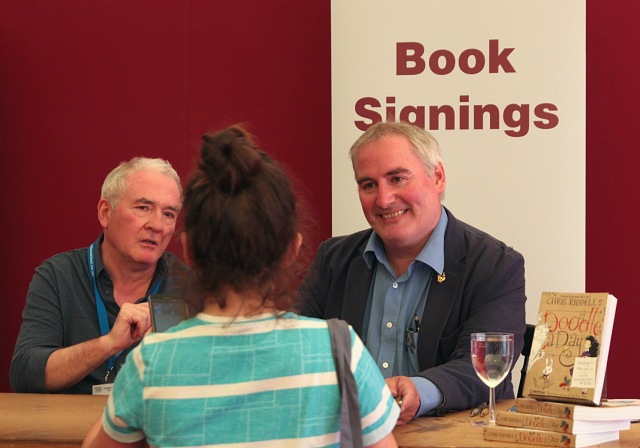
EdBookFest: Chris Riddell

IMG_0033
The Soibhan Dowd Trust Memorial Lecture: The Slipping Glimpse

Chaired by Tony Bradman

This is the third year of the book festival hosting the Soibhan Dowd Trust Memorial Lecture, the previous speakers being Patrick Ness and Matt Haig. The trust funds projects that bring books to underprivileged children and, as the Children’s Laureate, Chris Riddell spends a great deal of time bringing books and their illustrations to children all over the country. He seems proud to be giving the lecture and to have met Soibhan Dowd, however briefly. Six weeks after they met at a party he opened the Guardian to see her obituary and felt a great sense of loss that he had only managed the briefest glimpse of her and her mind.

The event had started late because they had been hoping to set up a display so that he could draw and have every line projected onto the large screen behind him. Presumably the aim was to emulate his recent forays into live drawing on Periscope. The display refused to work and was replaced by a flip chart and a pencil, which sadly remained untouched until the questions.

His work as an illustrator might be celebrated now, but it wasn’t at school. He went to the kind of school where art was considered a remedial subject. The kind of class you were sent to if you were troublesome, or they didn’t quite know what to do with you. Riddell loved art and excelled, but was forced to create academic links to legitimise his continued presence in such a remedial class. He was all set to go to university, when the art master declared him a natural illustrator and suggested he apply to art school. Applying to Epsom School of Art and Design a week before courses started worked out for him, much to the dismay of his school since he had won the school English Prize. Students returning to the school to accept a prize at Speech Day could select the book they would be presented with. Riddell’s request for Where The Wild Things Are was clearly met with disapproval, and when the day came the headmaster handed him the school library’s dusty copy of The Decline and Fall of the Roman Empire. Riddell accepted it and left the auditorium, walking straight into his art master who took the first book and handed him Where The Wild Things Are.

By the time Riddell finished at Epsom, he was twenty-two and knew everything, setting off to ‘audition’ publishers in London. He walked into multiple offices, rolling out huge charcoal drawings illustrating Gormenghast. He received vague interest but nothing more, until one asked ‘I can see you’ve been taught to draw, but where are your stories?’ Riddell stammered that he’d left his story at home and promptly rushed back to write one. Returning the next day with a short, illustrated story got the response of ‘This is fine, we’ll publish it’ and he found he had walked into the world of children’s books.

Some years later the Economist called asking for illustrations for twelve articles on the EU, a job that resulted in 9 years of work after the initial article run had finished. Work at the Economist was fun and he describes the office as being similar to a gentleman’s club full of clever, if impractically eccentric, people funded by very expensive advertising space. Everyone’s doors were always open, though that didn’t necessarily mean it was a good idea to just stroll in. Riddell once fell over an editor who was lying across the threshold of his office, staring at the ceiling while he tried to compose an article. Work with the Sunday Correspondent and the Independent followed, before children’s books called his name and he returned to publishing.

When he first mentioned The Slipping Glimpse as the title of his lecture, it seemed as though he was referring to his brief glimpse of Soibhan Dowd. He was in fact referring to something else entirely. He describes the experience of attending the kind of publishing world party where there’s plenty of white wine and everyone wears a name tag. At such events there are some who repeatedly receive the same reaction. Someone will start towards them, as if coming to start a conversation, their eyes will slip below the neckline to read the name tag, and then, at the last moment, move on as they change their direction to a more interesting name tag and its owner.
At one such party Riddell found that he and one other man were the main targets of that evening’s slipping glimpses. Recognising him as the father of another child at his son’s nursery, he went over to introduce himself and suggest they leave. A conversation about books they’d loved as children on the train home eventually turned into two book series, the Rabbit and Hedgehog books and the Edge Chronicles, the last book of which comes out soon.

At one point during his work on those series Bloomsbury called asking if he would like to work with a different author. The manuscript they sent him to illustrate was The Graveyard Book by Neil Gaiman. It was a job that blossomed into a wonderful working relationship, producing some truly stunning illustrations, recognition outside the world of children’s books and newspaper cartoons, and a great deal of mutual reblogging on Tumblr. Riddell views Gaiman as a kind of Gandalf figure (Riddell, of course, is Bilbo), inviting him on an adventure every time he hands over a batch of his words and lets him draw whatever he likes to accompany them. Sometimes it’s not even a manuscript. Riddell will take a quote from an interview or a short piece of writing and craft an illustration around it. After all, as he says: “I get to do a big monster and a sword wielding princess, what’s not to like?”

The online reaction to his illustration of Gaiman’s words led Riddell to seek out other quotes from other writers. Recent attacks on libraries meant he gravitated towards quotes discussing the value of libraries and librarians. In many areas libraries are the centre of the community and the only places some people can go to access both information and companionship. To stifle art is to stifle society and strangle social mobility. When we close libraries it is art and the community surrounding it that we kill. He emphasises that without books and libraries thousands are secluded even further from those around them and further impoverished. This is exacerbated by the fact that the libraries in poor areas where they are needed most are often the first to close.

Children in particular need an escape, and a resource that they can use to dream and learn. We can push children to do ever better in exams, to learn and recite ever increasing numbers of facts, but we cannot ignore the damage being done. An excellent mark on a difficult exam is worthless if it comes at the expense of the child’s current and future health. Another author whose words Riddell has illustrated has encountered this issue time and time again: “sometimes they get good marks, sometimes they cut themselves…we are experiencing an assault on childhood.” Riddell, like many other authors, seems to feel very strongly about the importance of libraries and their preservation. After all, libraries are the gateways to culture and community, education and social mobility. When a library is killed, many other things go with it.

EdBookFest: Val McDermid

IMG_0032_val

Chaired by Viv Groskop

The latest book coming out is Val McDermid’s 30th novel, and unsurprisingly she recently won an award for an outstanding contribution to crime fiction at Theakston’s Harrogate Crime Festival. Out of Bounds, published earlier this week is the fourth book featuring cold case detective Karen Pirie. McDermid didn’t expect her to become a series but some characters have a way of sneaking up on her, and Karen shouts a lot. Her comment that keeping going with Karen was partially born out of laziness so that she didn’t have to create a new protagonist has Groskop spluttering. As she points out 30 novels and numerous other projects doesn’t exactly look like ‘lazy’. If anything it looks maddeningly prolific. McDermid says she simply likes to try new things and find new challenges. Recent new challenges have included a children’s book, radio plays and documentaries. She does admire writers like Sue Grafton who can do one thing and keep it fresh and intriguing but her mind simply doesn’t work that way.

Groskop asks about how she feeds characters voices and finds ideas. They apparently don’t need feeding, the world is brimming with ideas and sparks for stories. A comment on the radio, an overheard conversation, a person in a cafe, a story someone tells. People do interesting and stupid things and ideas are impossible to escape. Often there are so many she has to hope some crawl off into a dark corner of her mind and die quietly. She also apparently frequently irritates her agent by appearing at events and telling stories about ideas that are three books away. Somehow I doubt the audience ever feels the same irritation about a glimpse into the mind and work of one of the queens of Tartan Noire.

Groskop wants to turn the conversation to McDermid’s hometown, Kirkaldy. However, she accidentally diverts the session by pronouncing it ‘Kir-cal-dy’ rather than ‘Kir-caw-dy’. A rumbling ‘Oooh’ and laughter from the audience leads McDermid to wave us down with ‘Calm down, she’s English, she can’t help it!’ Groskop decides to avoid further potential embarrassment by referring to it as ‘the place that you’re from’ from then on.

McDermid’s family were decent working class who believed the way to get ahead in the world was good education. When she was 6 they moved to a house opposite the central library and McDermid proceeded to read her way through it. You could take out 4 books at a time but 2 of them had to be non-fiction (a category that included drama and poetry), so she wound up reading a lot of things she might not have done otherwise. The librarians were eternally helpful and always patient with the fact that she was a child whose reading vocabulary outstripped the spoken, meaning that they managed not to laugh when she asked if they had any more of ‘those Norse leg-ends’. The only issue came when she ran out of books to read in the children’s section but couldn’t get access to the adult section. She soon found a solution by stealing her mother’s library tickets and asking for an Agatha Christie as her mother was ill. This excuse worked for years until McDermid was old enough for an adult ticket. Her mother didn’t know until she went with her daughter to an event at that library a few years ago and a librarian exclaimed ‘Oh, Mrs McDermid, I thought you must be dead!’

McDermid’s introduction to the idea that she could be a writer came when a character in a book she was reading became a writer and mentioned getting a cheque for their work. Her first thought was ‘They get paid for this? I could do that!’ Her parents were slightly baffled by the choice because it was not the life they’d ever had the chance to lead. However, they were supportive and once she got to Oxford McDermid began to wonder if she could write the great English novel. She describes her attempts at the task as ‘shite’ and subsequently decided to try something she thought she knew how to do, and she’s still doing it now. At the time no one studied crime fiction like they do now. She recently discovered that you can now do a degree in detective fiction and seems a little peeved she didn’t have that option. Despite never being able to study it McDermid never considered crime fiction to be intellectually invalid. It might not have been on the syllabus but the green spines of Penguin editions of Agatha Christie still sat on the office shelves of her tutors, right next to the books in her essays. In her mind Christie was on the same level as Asimov and all the others, so she sat down to write and discovered she could do it a lot better than the ‘great English novel’.

McDermid does like to start with a title in mind, meaning that she finds it rather irritating when her publisher decides it needs to be changed. One of her recent books had originally been given the title ‘Inveterate Scars’, until her publisher protested that he couldn’t sell that to Asda. ‘Unredeemable’ was deemed too long a word to fit on the cover while still a good size and in the end they settled on ‘The Retribution’. Another had originally been called ‘Bounty’, which was changed when the publisher became worried that readers would confuse it with another book published that year in a different genre. It seems that publishers often ascribe an astonishing lack of intelligence to their customers, though sometimes the comments of readers do strike McDermid as stupid. One woman sought her out on Twitter to say that she had been a fan but had just found out that McDermid was a feminist and was therefore no longer interested in her work. Incensed, McDermid replied that it was her loss and that she’d ‘probably struggled with them anyway’. That response caught attention, resulting in 12,500 retweets, a New York Times article, and the title of ‘Elle Malaysia’s badass woman of the week’.

Twitter and increased public engagement does mean that a writing career now is a little different to what it was twenty or thirty years ago. The increasing need to interact with readers does take up more time than was required of previous generations and McDermid worries about the online behaviour of some younger writers. Some seem to put up every tiny detail of their lives, public or private, meaning that when the sky falls they have no place to hide. McDermid engages but always makes sure to retain a layer of privacy into which she can retreat when some aspect of her career or personal life becomes difficult. She does however believe that some past authors would have loved the level of audience interaction allowed by social media. Dickens probably would have been on Twitter constantly. Personally, I would love to see what Shakespeare would have done with 142 characters.

EdBookFest: Jim Haynes


Photo courstesy of Antonia Reeve Photography
Chaired by Peggy Hughes

Jim Haynes is a fascinating figure. Grandfather of some aspects of Edinburgh’s cultural scene and a one man social network long before the creation of MySpace, Bebo, or later on Facebook. This is his 60th festival and he jokes that he’ll do another 60 and then call it quits. Born in Louisiana Haynes wound up in Edinburgh after being drafted. Managing to get into the airforce instead of the army he did well in initial training. When asked what he would like to do in the airforce he said that he already spoke Spanish but would like to learn Russian or Chinese and so was assigned to the Russian language school. He set about finding the officer who made everything happen and requested to be sent to the smallest possible base in Western Europe, preferably near a city. Three days later the man got back to him to ask ‘How does Edinburgh sound?’

He arrived in Edinburgh just after the festival in 1956 and got himself permanently assigned to the 5-midnight shift (along with permission to reside in the city) so that he could attend university during the day. He failed to mention to his superior officer that one of the things he wished to study was the anatomy of the future mother of his son. He got hold of a car so that he could drive out to the base and despite not smoking at all or drinking much he could get hold of cheap cigarettes and alcohol, so he was welcome as parties everywhere.

When the time came to leave the airforce his family said that if he returned home he’d be set up with a job, house, car, but if he stayed in Edinburgh he was on his own. He had a little saved up from chauffeuring an uncle before he was drafted and when he sold his car he was left with £600. On finding a run down antique (or really junk, he says) shop he walked in and said ‘Madam, I’d like to buy your shop.’ She replied that it was about time she retired and how did £300 sound and thus began the Paperback Bookshop, the first of Jim’s many lasting impressions on Edinburgh. A replica of the rhino’s head sits on the side of Edinburgh University’s Informatics building, commemorating the exact location of the shop. Nearby sits a large book with a theatre production set into one edge, referencing the productions that he put on in his shop before the founding of the Traverse.

The Paperback Bookshop was the location of a striking photograph. It sold a number of books you weren’t strictly supposed to sell, thanks to the censorship in place at the time. A woman came in asking for Lady Chatterley’s Lover, and when Jim confirmed that they had it she put her money on the counter and declared that she would be back for it in half an hour. Sensing something interesting about her behaviour, Jim called his photographer friend Alan Daiches, who arrived in time to see the woman return and carry the book outside using tongs so that she wouldn’t have to touch it. Once outside she doused it in kerosene, lit it, and ranted and raved about its awful contents for while. The pictures Daiches took went round the world and put the shop firmly on the map.

Every story Jim tells speaks of a remarkable, busy life. Not content with the Paperback Bookshop, he went on to start the Traverse Theatre Club (a club rather than simply a theatre so that they could avoid having to get scripts past the Lord Chamberlain and serve alcohol after 10 at night). Started in an upstairs flat on Lawnmarket, it grew and moved and eventually found its home on Lothian Road next to the Usher Hall and the Lyceum. He was asked to animate a theatre in London and after a highly successful year, moved on to start his own enterprise in two spaces in Covent Garden. One a theatre, the other a cinema, gallery, and restaurant. He has written books, some of which gave him the ‘godfather of the social network’ title.

Jim’s guidebooks were less about the sights and more about collecting the details of 1,000 people, able to speak English, who would welcome western tourists into their country. He did so successfully in Romania, Poland and then kept going, eventually resulting in an interesting research trip to Russia. He knew one man in town, whose event he went to see and who then said that if he stayed close they would both be invited to dinner with the mayor. The evening progressed as advertised and they found themselves at a dinner with a whole cast of some of the most important people in town. The mayor and his guests and staff and right down the end of the table, the ‘two schmucks’ who were the least important people in the room. Jim Haynes, and Vladimir Putin. 

Not content with his so far highly varied life, Jim moved to Paris and a teaching post at Sorbonne University, where he eventually started the longest running dinner party in the world. Every Sunday for the last 37 years he has hosted a dinner party in his atelier in the 14th arrondissement. Anyone in the world can go, provided they call and confirm a space. The Sunday before he came to Edinburgh for the festival 119 people came. Tens of thousands have come over the years. I attended, and helped prepare, three of these dinners in 2010, and took a friend a year later. They are wonderfully bizarre occasions that speak volumes about Jim’s love of people, new connections and memory for faces. Each one is presided over from his tall stool, where he greets old friends and new alike. The evening is peppered with his cries of ‘Julia, come and meet Michael!’ or ‘Who hasn’t met Pierre?’ He doesn’t seem satisfied unless everyone who comes has met at least one new person and somehow, it works. Despite it being a room filled with strangers from every corner of the world, there are none of the awkward pauses one might expect. Jim’s energy fills the room and that alone is a rich source of conversation if other things fail.

Listening to him speak in the corner tent in Charlotte Square gave a glimpse into the rich and varied life of an extraordinary man but it is as his dinners where you can truly see what he loves about the world and why he is so loved in return. His event at the book festival was sponsored by Edinburgh Napier University, who have started the Jim Haynes living archive. They collected vast amounts of paperwork from his house in Paris, from the hundreds of newsletters he used send and now posts online, to details of how many thousands have attended his dinner parties over the decades, to his letters and writing. An American university had also been interested in obtaining his archive but Jim felt it would be better sent to a university in the city where he made such an immense cultural impact.

EdBookFest: Sue Perkins

IMG_0030

Chaired by Viv Groskop

Viv Groskop was the perfect choice of chair for Sue Perkins. Two comedians playing off each other for a highly entertaining hour. Groskop begins by pointing out the Bake Off-esque overtones to some of the reviews of Perkins’ book, one of which called it ‘warm, crisp and beautifully layered’. Perkins laughs that it makes her book sound like one of the Bake Off’s Eastern European technical challenges. Spectacles is a memoir, which was written now because she feels that the time was right and she had something to write about. She despairs at the trend towards every emerging young celebrity to write a memoir, since at 17 you haven’t really lived yet and you only think you know everything.

The eloquent, confident woman on the stage is a far cry from the shy, stuttering child who got her first experience of performance in a nativity play. The first year she played the coveted star role of a fox, before moving up to 4th shepherd (out of 3) and then an angel in subsequent years. Later in her school career she went weekly to see a Miss Carol Schroder who got her to read out Shakespeare. Perkins learnt about phrasing and cadences and the shy, stuttering child began to fade. She jokes that Schroder had given her the gift of speech and in doing so, created a monster.

Arriving at university she soon joined the Cambridge Footlights, a society famous for having produced a remarkable number of Britain’s best comedians. She arrived in the society in part thanks to a dare from her roommate. Perkins admits that she has the flaw of wanting to do almost anything if she is dared to do it. On the second day of term her roommate dared Perkins to do a stand up slot at an event the next day. Perkins carried out the dare and in doing so met Mel, her comedic other half. Perkins explains that for a while during their university days Mel had pretentions to be a ‘serious actress’ and was always appearing in one serious drama or another. Eventually she sent Perkins an entertainingly formal note that read ‘Dear Susan, would you like to do a double act with me? Love Melanie’. Perkins agreed and their wonderful partnership was born.

Their first show as a double act was at the Fringe in a tiny room on the top floor of C Venue at 10:05 in the morning. On the first day no one came at all. The second day gave them an audience comprised of a single American tourist. The woman never removed her backpack and half way through the show began unfolding a map, which grew until they could not see her at all. The biggest audience they managed in that run was just 12 people but Perkins says she loved those times. Groskop asks how she kept going and Perkins dryly suggests vodka, before launching into an explanation. She says it wasn’t so much self belief as ignorance. At that age no one gives you boundaries so she just blathered into things and hoped they worked. The first time they actually made a living at comedy was when they sent in a script for the Radio 1 show Weekending. They received a cheque for £11 and were so excited that they had proof of their ability to make money that they never actually cashed it.

The duo carried on and eventually landed the Light Lunch show. They weren’t the only hosts considered for the show but, in Perkins words, the producers decided to go with anarchy and see what happened. She describes the show as being an amazing playground, stating that they had no idea how lucky they were. However, after a time Mel decided she wanted a family and for the first time she was going on a journey that Sue couldn’t follow her on. At the time it had felt like the end of the world but they grew up and better and returned to dance their duet on other shows.

Going on to talk about Maestro, Perkins explains that she didn’t initially want to do the show. It sounded weird and, feeling vulnerable, she didn’t like the idea of the public vote. In the end her friend Debbie (who promptly waves from the front row) persuaded her to do the show, which wound up being one of the most incredible experiences of her life. She turned down the Bake Off three times as well, these are both things that make her glad people refuse to leave her solely responsible for her own career decisions. Maestro made her see the world differently at a time when she needed it. Nothing can compare to conducting Elgar in the Royal Albert Hall and the emotion involved was intense. Perkins admits that a lot of her verbiage was a defence mechanism but she found it intense and liberating to communicate with music instead, even if she did cry.

Groskop finally directs the conversation to the Great British Bake Off, something she’d been dying to do judging by the visible excitement. She reveals she once baked for Mary Berry, getting the feedback that her brownies were dry, her lemon drizzle close to being good, and her rock cakes ‘good for a child’s lunchbox’. Perkins laughs that attempting lemon drizzle for The Mary Berry was a brave move.

Perkins wasn’t sure about the show when she was first approached and she certainly never expected it to grow to the phenomenon it’s become. She was once accosted in Bridgewater service station by two people desperate to know who had won the series airing at the time. They followed and persisted until she eventually blurted out the name of someone who wasn’t even on the show, leaving them satisfied long enough for her to make an escape.

Despite such encounters she does truly love the show. Nadiya, last year’s winner, is the most conspicuous example of the good it can do but Perkins explains that the show changes everyone on it, even the ones that leave in the first week. A great deal of what she and Mel do on the show is off camera pastoral care. The pressure and atmosphere in the baking tent is intense and they feel awful when things go wrong. She only watches bits of the show, when recording voice overs, but she remembers clearly that one of these moments made her cry. The segment showed Dorret talking enthusiastically about her chocolate cake and how much she loved the recipe and the ingredients she had used. Then she lifts the sides of the tin and a small amount of the mix leaks out the bottom. Dorret’s response was to slam the side down again to contain the leak of something that had gone horribly wrong and stare in disbelief. The level of precision had become so high that while mistakes still happen frequently, the show has become more about the emotional journey of the contestants, making moment’s like Dorret’s all the more heartbreaking.

Perkins does admit to some of the disasters being her fault (not that anyone who watches could forget her elbow sinking into Howard’s buns). Every year she tries to keep herself in check and every year has to admit to something being her fault instead of the contestant’s. I’m sure I’m not the only one who wondered if that comment meant there was another disaster with her name on it this year. Despite elbows going into buns, or ingredients into her mouth, Perkins said she is proud to be part of such a nice, loved show. She certainly appeared to be enjoying herself on its return to BBC1 on Wednesday night.

EdBookFest: Laura Bates

Chaired by Jenny Niven

Laura Bates is a name known to feminists and sexist trolls alike. Founder of the Everyday Sexism Project she has collected hundreds of thousands of stories of acts of sexism that happen every day. Comments are made about dress and looks in the workplace. A man on public transport makes eye contact with a hand down his pants. A comment out loud about having been groped gets ignored by the rest of the passengers. Bates has done great things with her project and been both rewarded and viciously attacked for it. She has received a British Empire Medal. A collection of stories from her project given to the British Transport Police led to the retraining of 2000 officers, an awareness campaign and a 40% increase in reporting of harassment. All the while she endures messages from violent trolls laying out various scenarios in detail, such as the knife they would use to disembowel her as they raped her.
As part of her work she advocates improved sex and relationships education in schools. Many children get nothing from their parents and Bates dismisses the claims of MPs that children need protected from too much information too early by pointing out that they are already exposed. 60% of 14 year olds have seen porn, often depicting violent and humiliating scenes. While working with one school Bates was approached by a 13 year old girl who was terrified of the entire idea of sex because a boy had shown her a video on his phone where the girl was crying and hurting. In another school a 14 year old boy raped a girl and when asked by a teacher why he hadn’t stopped when she started crying he protested that it was normal for girls to cry during sex.
Approaching the idea of a child simply being curious about the word, Bates searched ‘porn’ in Google. The first page featured stills of 3 videos with captions declaring scenarios such as ‘teen gets arsehole smashed’. An add in the sidebar featured rotating images of women being taken from behind and bore the title ‘Punish Tube’. The immediate message for anyone just wanting to even know what the word porn means, is that sex is painful and humiliating for girls and that this is completely normal. When we stay silent we are not protecting them, we are being actively damaging. We teach children to read maps and who to call for help if they get lost or into trouble but we say nothing about how to navigate relationships and sex in a world that leaves them increasingly exposed to very damaging images and ideas.
As part of her drive to increase the effectiveness of sex education Bates has written Girl Up. It is a mix of explaining sexism in every form, ideas on how to teach people to deal with it, and strategies for dealing with the types of everyday harassing behaviour we sometimes struggle to respond to. She presents a series of pictures that can be sent as message responses to the joys of being sent and unsolicited dick pic, or someone asking that you send them a nude photograph. Among the options provided is a picture of balloons bearing the caption ‘Congratulations, you have a penis!’. Another is a drawing of two blue tits, one of which is giving the middle feather. You also have the option of sending pictures of pairs of melons, bongo drums or huge bazookas. A similar section presents potential responses to pick up lines. The suggested response to a crude line like ‘my dick isn’t going to suck itself’ was ‘well, it’s got good taste then!’ She also tells the story of a woman who had abuse shouted at her by a workman on a roof. When her enquiry into why he was shouting at her was met with further, more extreme abuse she responded by taking his ladder and lying it down, leaving him stranded.
A teacher asks for hints on how to get secondary school students to listen and then to talk. Bates explains that the best responses come when the students get to talk as much as possible. Starting a discussion by asking ‘What do girls worry about as opposed to boys?’ generally results in an animated discussion where they explain many problems of sexist views to each other. However, as Bates points out, there are often other problems and forms of oppression that are heavily linked to sexism and cannot be separated into a completely distinct issue. Racism, ableism, transphobia, homophobia, ageism. All of these play into sexism in different ways. The wage gap is much higher for black women compared to white women. Add in a disability and the gap gets larger still. Homophobia takes different forms depending on if it directed at men or women. Gay or bisexual men get insulted and bullied and beaten up. For a woman entering into a relationship with another woman, it is likely that at some point a man will talk about how ‘hot’ it is and ask if they can watch. I have been looked at like some twisted fetish brought to life and it is not a pleasant experience.
This is a book that deserves to have a large impact and can do a lot to support young people emerging into an increasingly dangerous online world, especially if thorough sex and relationships education continues to be withheld. As Bates points out the battle of feminism towards an equal society has come a long way but we must go further still. She is also sure to point out that as dangerous as the Internet can be, it has positive aspects as well. Her project and two books would not have got started without social media and every day she watches women from around the world forming an online community to provide the support that not all of us have access to in the ‘real’ world.

EdBookFest: AC Grayling – The PEN HG Wells Lecture

This is the second year that the book festival has run a lecture in conjunction with English PEN. In Introducing AC Grayling, Nick Barley, the director of the festival, quotes last year’s speaker Ali Smith, who’s talk was published by Penguin as a foreword to their reprint of HG Wells’ The Rights of Man. She had told him that when speaking to a child she had asked what fiction was. The child replied that fiction was ‘made up truth’. Barley thinks that this defines the role and power of fiction rather well and then asks if philosophy can match fiction in it’s ability to think and imagine. The best philosophers are brave thinkers and, as Barley puts it, the world needs a lot of them right now. AC Grayling is one of those brave thinkers. One of our best known philosophers and a great lover of the power of fiction.

Grayling views Wells as a literary hero. He was a prolific writer and a good example of where imagination can take us. Wells combined intense imagination and thought with a great desire to know as much as possible. He was self taught and among many during his time that valued not just knowledge but thorough understanding, a trait Grayling feels is displayed in his work. It is frequently clear that Wells had a deep understanding of what he wanted a particular story to tell the reader and was a great reader himself. Grayling is unsurprised by this passion for reading, as any writer or aspiring writer should know that to write is to read. You can’t succeed at the first task without doing a great deal of the second.

There are questions about some aspects of Wells’ work. The good points of anyone’s work should be appreciated and the bad ones explored but, as Grayling points out, the context of his time and contemporaries must be considered. Some of his thinking was heavily influenced by the rise of eugenic thought after the revelations of Darwin’s evolution. However, Wells enjoyed taking an idea, considering the potential consequences and following them through to their logical conclusion. The Time Machine explores two possible end points of a drive towards a perfected human race, both of which end poorly. It seems to suggest Wells thought perfection an unrealistic goal as it was struggle and imperfection that made us human and made us live. Grayling proposes that if we could transport Wells to 2016 and give him the complete history of the decades since he lived, he would probably agree with many modern ideas about life and indeed eugenics.

Wells was a great believer in science literacy. Not that everyone should be a scientist, but that every member of the electorate should be able to understand what is happening in the field and appreciate the details of news reports on the subject. Grayling despairs at the acres of print given over to football compared to the mere inches expected to adequately report on every domain of science. An appreciation of the discoveries and future possibilities of science is vital. Grayling speaks of a conversation he had with one of the scientists involved in the search for the Higgs Boson. He asked how exciting it was to finally be going to print with the confirmation that the particle had been found. The reply surprised and delighted him. The man felt that while it had been extremely exciting, it would have been even better if they had not found it because then there would have been a whole knew avenue of work to explore. 

It is that kind of attitude that Wells would probably have appreciated. He felt that the best way of showing the importance and impact of science is to tell people stories. To show them what science is and where it might take us. When writing science fiction Wells stated that you must have one impossible thing and have everything else utterly plausible so as to give that impossible thing the largest possible impact. The Time Machine touched on Darwinian and eugenic thought but also beautifully explored contemporary ideas about the physics underpinning the universe. Time was considered the 4th dimension and if you could travel in every other dimension then why not the 4th? Wells took that question and explored its consequences.

Part of the role of fiction can be to take science as it is and explore its potential consequences. Wells took the practice he had used in fiction and applied it to the problems of society. With one world war behind them, another looming, and fears of aerial warfare becoming a main form of conflict, Wells and his contemporaries began to see two inevitable conclusions. Either we would find ever more destructive ways to wipe each other out or we would need to find a way to establish a world government to keep the peace. Wells was at the forefront of the group attempting to warn people about the potential horrors of aerial warfare and prevent them from ever happening.Sadly once the cats of science and technology had been let out of the bag, nothing could persuade them back again. When war started again it wasn’t until the atom bomb that their greatest fears about aerial warfare were realised and the world has been reeling ever since.

Wells took to trying to put the world to rights through writing. He wrote about the need for universal legal structures and universal human rights. While his contemporaries took to opening schools to try and educate the young in order to prevent future catastrophes, Wells recognised that education was not limited to the classroom. If people could be persuaded to be lifelong self educators then society would improve. Churchill once declared that the strongest argument against democracy was a minute’s conversation with the average voter. Wells wanted to push for a thoughtful, educated electorate invested in the common wheel, which 2016 is showing to be a rather wise goal.

EdBookFest: Alexander Masters

A life discarded
Chaired by James Runcie


And so the book festival begins once again. I arrived on the first day to hear Alexander Masters telling the story of 148 diaries found in a skip in Cambridge. They were originally discovered by two of his friends, whom he calls unlikely academics. One, a professor of ecology, was exploring a building site and came across a skip filled with a number of things, including a large assortment of books. Unable to get into said skip he called a more agile friend from the literature department, who managed to clamber in and extract all 148 volumes. Several years later she passed these volumes on to Masters, thinking he might find some inspiration for a book in the dense writing inside.

The diaries spanned a period from 1952 to just two weeks before they were found in the skip. All a standard A5, they ranged in colour from the plain muted colours of post war rationing to the lurid pinks and oranges of the 90s. Each one covered about six weeks and was filled with compressed writing from the first possible page right the way through to the end, often with later notes added in the margins when the writer ran out of room. 

One of the first things Masters read when opening one at random was the writer expressing a hope that their diaries would never be blown up. After that intriguing start he also developed an interest in the little sketches and cartoons that dotted the pages. He became entranced in attempting to discover who this person was and what they were like. The problem with a diary is that the diarist doesn’t necessarily describe themselves in any useful manner or mention details that might explain otherwise confusing passages. There were a great many references to one particular ‘it’ that must be done, as if the writer’s life depended on this task being successful, but absolutely no explanation of what this ‘it’ might be.

It’s 5 million words in 148 books, you’ll go mad!

For a time Masters resisted investigating the diaries too deeply, figuring that he would never get through them all and would simply end up frustrated and wasting time he should be spending on other things. However, he couldn’t help picking them up occasionally and on one occasion came across a passage describing what initially appeared to be a stabbing. The diarist had described themselves stumbling around the garden before rushing inside to attempt to find the phone book and call the hospital (since it was before the convenience of 999). When the diarist’s mother came home she appeared utterly unconcerned by her child’s distress. The end of this passage made the reason for this clear. The diarist that Masters had assumed was male, was in fact a 14 year old girl writing about the arrival of her first period.

A brief worry about a man reading a young girl’s diary being creepy was quickly overshadowed by the knowledge that he had 148 volumes of writing telling him exactly how a woman thought. He continued reading and discovered a series of drawings from the set of the Richard III film that had featured Lawrence Olivier. The immediate thought on discovery of these sketches was the possibility that she might be famous. However, the more Masters read, the more he hoped she was not famous. If she was an ordinary person then he could feel a sense of equality between him and his subject. Celebrities were always watched and written about and consistently aware of that fact, whereas what he had was a completely unselfconscious body of work. Part of the appeal of the diaries came from the idea of this being a normal person, facing normal problems and Masters found himself taking comfort in the fact that she faced the same issues as him and solved them in similar ways. His original intention to actually find the writer was replaced by a desire to figure out her character and personality and extract as many clues from the writing as possible.

The writing slanted across each page and Masters knew that she wrote in bed. Struck by a wish to discover if she really was as tall as she frequently complained, Masters found himself a protractor, consulted a mathematician friend and attempted to find a formula that would take the angle at which the writing slanted giving him the length of her forearm, and eventually her height. With the formula checked by his friend and the angle measured Masters completed the calculation and received the answer that his diarist was 25 feet tall. Back to the drawing board.

There were frequent references to an ‘E’, who seemed to be the great love of the diarist’s life. However, Masters concluded that there was another love. A man referred to as Whiters, who was frequently described as bringing her far more satisfaction than E could. Eventually the identity of Whiters was solved when a scrap of paper fell out of the diary bearing the address of Whitefield House, Cambridge. Attempts to contact the owners and get permission to access the house that had clearly meant so much failed. Masters eventually found himself sneaking through a gap in a cordon to find that the house had been razed to the ground.

The mentions of E proved more informative. Having previously only known that the diarist’s name was not Mary (due to a discussion of a boy who had made a pass at her but uttered entirely the wrong name), he then came upon a section where E had been quoted, and the quote included the diarist’s name. Laura* was frequently berated by E, who appeared to be a piano teacher and former concert pianist. Masters gathered a picture of a man who had been at the start of a career but forced to flee to England when it became clear that Jewish concert pianists would not be tolerated at home, who then pinned all his hopes on making Laura everything that he could have been. Sadly Laura had neither the enthusiasm or the discipline to fulfil his dreams and his frustrations at this were taken out on her.

As the diaries continued it became clear that not only was E 50 years old when Laura was just 14, E was also female and the diaries documented a 30 year unconsummated relationship. It seems that while many 14 year olds fall in love with a lot of people, some of them a great deal older, Laura became trapped in that moment of teenage precariousness. In earlier years she seems to want her diaries seen and read so that she might have a forum in which to discuss her odd relationship with E. However, as the relationship, and subsequently the diaries, sours she seems less concerned with the possibility of an external reader. The later diaries are filled with minutiae that are boring but fascinated. The chair Runcie notes that at one point she spends 2 pages discussing her radish intake.

Oh god, I know everything!

Eventually it became clear that Laura was in fact still alive, and Masters would have to contact her if he wished to go anywhere with the book he had written over his years of investigating her words. Managing to track her down he arranged a meeting, only realising on her doorstep that he was about to tell a complete stranger that he knew all about her inner thoughts from her description of her dramatic entrance into puberty to her many thoughts on E and their relationship. Laura initially assumed he had contacted her as he was writing a biography about someone she knew but did seem very taken with the idea of his book. She even said that she did not want him to remove anything as it would not be honest. Her only objections in the whole manuscript were regarding some of the drawings that he had included. She now keeps two diaries, one for herself and one for Masters.

Initially it seems that Masters is touching on the tired stereotype of a woman being the great complex mystery a man must take pains to unravel, and his description of his discovery of both Laura and E as female flirts with being grotesquely sensationalist. However, when the rest of his work is considered it looks more like a man who is fascinated by the inner worlds of others and is desperate to find out all the ways in which they are similar or different and how that informs their choices.

*This is the name Masters gives in his book, however, it is not the diarist’s actual name as it was changed to protect her identity.

Chris Brookmyre: Black Widow

CBrookmyre

Over the last few years Blackwells have apparently lured Chris Brookmyre to do several events in Edinburgh by promising to book The Caves for the event. It’s easy to see why. Set up in one of the high arches under South Bridge the venue is lit to emphasise the rising stonework and the walled up doorways near the ceiling that show its long history. The introduction of Brookmyre includes a joke that we won’t be asked to turn off our mobile phones, as there is no signal. There is a bar upstairs but even there getting card payments to work took effort. It’s an unusual and atmospheric venue that perfectly suits Brookmyre and his stage presence.

Brookmyre begins by stating that he is very excited, more so than normal, as he considers Black Widow (out next week) to be one of his best. Critics have been loving it and declaring it a work of feminist crime fiction. He is glad they have stated that for him as he feels that it is too easy for a man to lay it on too thick when discussing feminism. He worries not just about sounding patronising but that he might risk making being female sound like a disability.

“Carol changes her clothes up to five times before leaving the house, just £2 a month from you can help her.”

A laugh from the audience encourages him as he continues, commenting on women being declared ‘too sensitive’ and joking that men are so well known for their proportional response to feminism.

From the section of Black Widow he reads, and his further comments on the book, it appears that the stereotypes surrounding men, women, and feminism are key to the story. The book begins with the thoughts of Diana Jaeger as she sits in her trial for murder. She contemplates the fact that she knows the jury have already decided she is a monster, the media have made that clear. She feels indignant at the air of ‘how dare she?’ which echoes through the media coverage. As she points out, no one ever asks ‘how dare he?’. A man killing his wife results in discussions of the ‘tragic’ situation and wanders into victim blaming. Articles on wives killing their husbands never stray into “He must have known her triggers.”

Long before her marriage, crime, and trial, Diana Jaeger was the anonymous author of a blog about sexism among surgeons in the UK. Her moniker Scalpel Girl is predictably perverted into Blade Bitch when the blog goes viral. She writes about the comments female surgeons get and how easy it is to ignore the constant background hum of harassment and forget its dangers. Another entry discusses jibes about female surgeons having too much or too little cleavage for the job, before musing that perhaps the Royal College of Surgeons should provide a definition of the ‘ideal standard career tit’, to be used as a template for appropriate surgical intervention. The blog inevitably results in the rape and death threats “we have come to expect” and the comment sections fill with the “full bullshit bingo card”, echoing the saying that the response to any article on feminism, justifies feminism.

It seems as though Brookmyre has taken everything we feel resigned to accept as normal about sexism and feminism, both online and off, and written it into a narrative in a style that strips away any wool that has gathered to make it dance and emphasise it’s appalling nature. During the questions he says that he finds passions to carry him through books, often things he passionately hates, and likes to write fiction that engages with society. In Black Widow he has taken a subject that inspires ranting in almost everyone and transformed it into a gripping tale, which will undoubtedly inspire further ranting.

The questions session is a reminder that while Black Widow is a crime novel about a fairly serious topic, Brookmyre is also engaging and funny, both in writing and in person. He puts everyone at ease by describing the worst question he’s ever received at a book event, to reassure us that we can’t do worse. He was apparently doing a signing in Costco in Swinbourne, sat on a chair that had still been flat packed minutes before his arrival. He was at a table piled with his books and surrounded by posters, most of which had his face on them. An old man still managed to walk up to him, lean round the books and say “’Scuse me, you got a gardening department?”

One audience member asks about getting the perspective right for writing from the point of view of a woman. Brookmyre explains that he was never a laddish boy and never identified with the idea of being macho. As such he finds writing women easier than an SAS hyper-masculine type. He adds that growing up around opinionated women probably helped, and that being Scottish “They didn’t miss and hit the wall when talking to you.”

He segues into an anecdote about a woman who emailed him objecting to his use of the word c*nt in Bedlam, declaring that she’d read all his previous work and couldn’t understand him using this to ‘jush up’ his writing. His reply, after a search of previous books, was that he had used it previously, in fact he stated that he would love to know how she failed to be offended by the 250 previous appearances of c*nt in his books, 65 of which appeared clustered together in Tale Etched in Blood.

Other questions focus on the changing world of publishing and the difficulty in translating work that is very much Tartan Brand. Brookmyre feels that a good editor is key in publishing but that the entire industry has become much more prone to micromanagement in recent years, even fussing about titles in a way that they didn’t before. He thinks this might change soon as they’re beginning to relax after a bounce back from the blows of Kindle. He is lucky in that he has worked with Orbit as well, and so is able to switch to writing Science Fiction without too much trouble, which he will be doing when he’s finished the next crime novel. Translating Tartan Noire is a different question and he explains that it’s done with difficulty and sometimes badly. To a certain extent it’s less about the language barrier and more about the culture. His books sell where people can identify with them.

Brookmyre ends by reading a short story he was asked to write as part of the celebrations surrounding the Commonwealth Games in Glasgow. The brief was to write a story inspired by the Kelvingrove Bandstand and his resulting work was titled “Puck Knows”. It features a crowd arriving to watch a production of A Midsummer Night’s Dream. Among the crowd are a reluctant group of teenagers, whose comments about how Shakespeare is “Like f*ckin’ Cbeebies, ‘cept it makes less sense” go unchecked as the teachers sensibly chose the seats furthest from the students most likely to ruin their night. Despite sounding like typical troublemakers they do initially pay enough attention to pick up on all the dirty jokes their teachers can’t or won’t cover, making dirty comments in return.

The continuing story had us all roaring with laughter every few lines as it proved to be both brilliantly Shakespearean and utterly Glaswegian. Brookmyre was, as always, hilarious, clever, and entertaining. Interestingly, while crime fiction events often result in a largely female audience, Brookmyre attracted one that was predominantly male, all of who seemed to be thoroughly enjoying themselves and his jokes. It was a fitting reflection of Black Widow’s use of gender stereotypes and the realities they ignore.

In an evening filled with clever jokes and plays on words, the organiser’s final remark that Black Widow would make an excellent wedding present seemed an appropriate way to end.

Mary Beard: SPQR

Mary Beard

Douglas Jackson, author of novels set in Ancient Rome, apparently replied with an emphatic ‘Yes!’ to the email asking if he would like to be the chair of this event and it’s easy to see why. Mary Beard is one of those rare academics that are very good at speaking to the public and she does so regularly and colourfully. Her new book SPQR is a history of the Roman Empire, on a monumental scale (and weight judging by the size) and with real academic vigour. One reviewer described it as a book where even those who know a great deal of Roman history will find themselves learning more and even questioning what they thought they knew beforehand.

When asked why the title of SPQR (which stands for Senatus Populusque Romanus) was selected Beard explains that these are possibly the most famous set of initials in history. The phrase means ‘the Senate and People of Rome’ and is still used within Rome today, often seen stamped onto infrastructure like bins and manhole covers. It is how Rome referred, and refers, to itself. It also links into the aim she had for the book, which was to write a history of the Roman Empire that put the people back into the story. She obviously didn’t want to write out the Senate and the politically important but she also wanted to emphasise the importance of the general population. She’s taught Roman history for 40 years and feels like she now has something to say. She then joked that she also felt that she had to do it now because if she started a book on such a large scale after 60 she might never finish.

Beard then explains that studying the history of Rome is like walking a tightrope. On the one hand you have the utterly familiar parade of day to day life and family squabbles but on the other you have the totally foreign ideas of slavery and people, quite literally, throwing away unwanted children. She wanted to try and capture how to deal with studying a people who were very like us but also horrifyingly different. There are even elements of some periods that shocked later Roman historians. 150 years before Julius Caesar there were pairs of Gauls and Greeks buried alive in a sacrificial ritual. This obviously seems horrifying to us but later on there were Romans writing about how it was shocking and a very ‘unroman’ ritual’.

She also warns that it’s often all too easy to slip into moralising about the Romans. We view slavery as barbaric and as an area where we can feel superior even though we are all aware of, and hesitant to confront, modern examples of slavery. Additionally we look at the Roman slave trade through the lens of the transatlantic trade and all the baggage that comes with it. Multiple Roman industries were dependant on slave labour and some of it was dangerous gruelling work, like mining, but these were not typical slaves and there was no typical slave. Miners would have had very poor life expectancy but if you were a secretary or a doctor (professions dominated by slavery) then you would have a much better life than many of the free poor. We have documented evidence of deep relationships and slaves growing rich. Some masters and mistresses freed their slaves and then married them and yet there was also the contrasting element of slaves essentially being viewed as human machines. Domestic slaves were freed in vast numbers but it was in a way similar to how we treat household machines now. If you want a new fridge, you go and buy the one best suited to you and then when it gets old and creaky, you get rid of it and buy a new one. Beard points out that some slaves must have been terrified of being freed because their support and security would disappear, and there was no state support for the destitute, you either found a way to feed yourself or you died.

SPQR begins, not with the origin myths of Rome, but 600 years into the Empire with Cicero reaching the peak of his career and finding a terrorist plot. He executes those he thinks responsible without a trial and sparks discussion of the clash between security and the rights of individuals, a clash that has been repeated down the centuries and is particularly relevant today. She uses this moment as a springboard into the roman world and then looks at the origin myths from his point of view. She then ends the book in 212 AD when the Emperor Caracalla extended roman citizenship to all free occupants of the Empire, dramatically expanding the number of citizens by about 30 million. This marks the close of a particular period of roman history and sparks discussions of the worth of citizenship and a scramble for new hierarchies to differentiate and exclude.

The expansion of roman citizenship is a vital point because ‘civis romanus sum’ (I am a roman citizen) had long been an important political slogan. It has in fact echoed through history and JFK quoted the phrase in his ‘Ich bin ein Berliner’ speech. Rome had never claimed to be a democracy, despite democratic elements, but it was concerned with rights and freedom. Civis romanus sum was a phrase used to boast and to invoke a sense of belonging, even though it’s most famous utterance was tragic in that a roman citizen was screaming it while being wrongly crucified by a corrupt governor in Sicily. Despite this event and the fact that the associated rights are hard to pin down the phrase held a powerful ideological resonance. And they didn’t have to pay or take an exam full of ridiculous questions to get it.

Jackson asks if discoveries have changed our views and Beard’s answering ‘yes’ is emphatic. The tablets from Vindolanda rewrote how we viewed army operations along Hadrian’s Wall. One of Beard’s particular favourites was the discovery of a cesspit in Herculaneum, which meant that they no longer had to guess at what was being eaten, they could know. She laughs that it’s like looking at a dinner party from the other end.

We are also asking different questions. When she was an undergraduate women were not mentioned once and the rape of the Sabines was only briefly mentioned. Now there is a concerted effort to find the voices of women and an understanding of the issues involved in the rape of the Sabines. These were issues the Romans worried about as well. Over the centuries you can find Romans debating the nature of rape and marriage and consent, as well as the issue of consent when you are completely ignorant of the concept. These were not questions that anyone would have thought of when she first began her study, but they’re being asked now.

An audience member asks what inspired her to study Classics and Beard jokes that initially it was simply because she was good at Latin. However it was the physical remains that really fascinated her. She grew up near a large roman site and was entranced by the idea that the romans were just below the surface, that you could scrape off the soil of today and find them underneath. Archaeology has developed a lot and added an array of scientific techniques to its résumé but she is still excited by the simple idea of digging a little bit of Rome out of the soil. It’s also easy to see the material remains and the influence they continue to exert. She jokes that looking around Edinburgh she thought it should be called the Rome of the North rather than Athens. However she does believe that roman literature has had a stronger influence than we might initially imagine. The Aeneid was and still is a hugely influential work and she thinks that there has probably been someone somewhere reading it every day since Virgil died. Echoes of its influence can be seen in almost every major point of western literature since Dante and Dido remains a figure in public consciousness. Her favourite piece of literature is not the Aeneid but Tacitus’ History of Rome. She laughs that it’s probably the most nasty, cynical, and powerful analysis of one man power there has ever been.

The audience seemed to be half star struck students (some stroking the covers of their shiny new copies of SPQR) and throughout the evening Beard held the attention of everyone with ease. There are very few academics who can inspire an atmosphere similar to a concert but this is something she does well.